

How to Choose Ethical Faith Based Clothing in 2026
Posted by Editorial Team on on 7th Nov 2026
Last Updated: November 7, 2026
Quick Summary
Ethical faith based clothing is apparel that carries a Christian message while treating workers fairly and supporting a named cause honestly. To choose it, look past the design and check where donations go, how factories pay workers, whether the fabric and print hold up, and whether the brand can answer hard questions.
- Look for a specific named charity and a stated amount or percentage, not vague "community" promises.
- Confirm a donation partner holds 501(c)(3) status through the IRS Tax Exempt Organization Search.
- Treat certifications like GOTS, Fair Trade and OEKO-TEX as different checks, each covering a different part of the supply chain.
- Compare sizing charts by chest and length measurements rather than letter sizes, since labels vary between brands.
- Divide the price by expected wears to compare cost per wear, which often matters more than the sticker price.
Table of Contents
- Step-by-Step Checklist for Evaluating Faith-Based Brands
- How to Verify Ethical Claims and Certifications
- Judging Fair Labor, Sourcing and Supply-Chain Transparency
- Ethical Christian Clothing Brands Worth Comparing
- Modern Christian Clothing: Judging Faith Messages, Design and Quality
- Christian Clothing Brands Streetwear: Fit, Durability and Budget
- Booking Your Next Step: Choose a Brand You Can Trust
- Frequently Asked Questions
Choosing a faith-based shirt often means looking past the logo to see what sits behind it. Ethical faith based clothing is apparel that carries a Christian message while also treating the people who make it, and the cause it supports, with honesty.
Most shoppers buy a faith-based shirt for two reasons. They want to say something about what they believe, and they want to feel that the purchase does some good. Both goals are fair. The problem is that a message alone proves nothing about the business behind it.
Here is what ethical faith based clothing usually includes in practice:
- Clear charitable commitments: A named cause, a stated percentage or fixed donation, and a way to see where the money went.
- Fair labor standards: Factories that pay workers properly and follow safe working conditions.
- Honest sourcing: A brand that can say where its fabric and printing happen, even if it cannot name every supplier.
- Faith messaging that fits the wearer: Designs that express belief in a way that matches the buyer's comfort level.
A common mistake is treating "Christian" and "ethical" as the same thing. A brand can share your faith and still cut corners on labor or quality. Check the values separately.
Keep this in mind as you read on: a good faith-based brand should be willing to answer hard questions. If it avoids them, that tells you something.
Step-by-Step Checklist for Evaluating Faith-Based Brands
Use this checklist before you add anything to your cart. The goal is not to find a perfect brand, no apparel company traces every thread, but to separate brands that can show their work from brands that only talk about it.
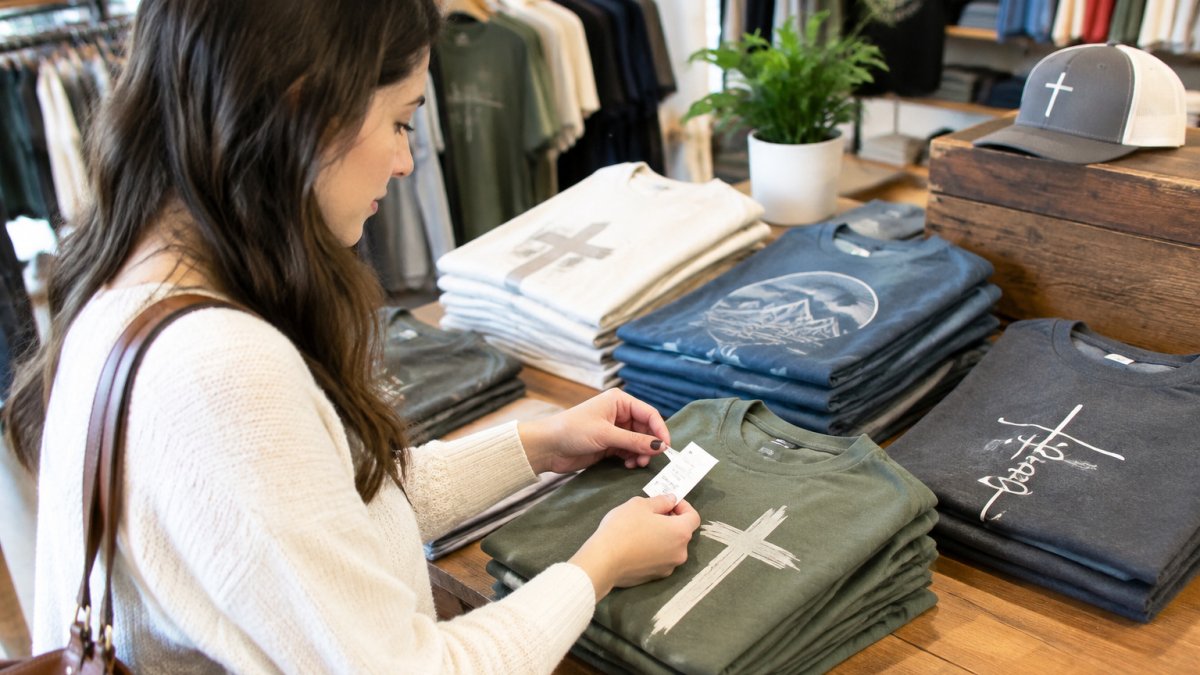
- Find the charity details. Look for the specific organization named, not just "our community." A legitimate partner will have its own website, a mission statement, and a way to donate directly. If the brand only names a cause category ("clean water"), ask which organization receives the funds.
- Ask how much goes to the cause. A vague promise is weaker than a stated amount or percentage. Look for language like "5% of every purchase" or "$2 per item" rather than "a portion of proceeds." If the brand publishes an annual giving report, read it, the numbers should match the marketing.
- Check the fabric and print. Read the product page for material composition and print method. Heavier fabrics tend to hold their shape longer than lighter ones, which may be softer but less durable.
- Read reviews about shrinking and fading. Repeated complaints about these issues are a warning sign. Sort reviews by lowest rating first, that is where construction problems show up. A few complaints are normal; a pattern across multiple reviewers is not.
- Look at the sizing chart. Compare it to a shirt you already own that fits well. Measure the chest and length of your best-fitting shirt and match those numbers to the brand's chart. Sizing labels vary widely between brands, so numbers beat letters.
- Review the return policy. Know what happens if the fit or quality misses the mark. Check the return window, who pays shipping, and whether sale items are excluded. A brand confident in its product usually offers a straightforward return process.
- Confirm the message matches your comfort level. Some designs are bold, others are subtle. Think about where you will wear the garment, work, church, school, or the gym, and choose a design that fits those settings.
- Calculate cost per wear. Divide the price by the number of times you expect to wear it. This number often matters more than the sticker price, especially for everyday pieces.
- Check care requirements. A garment that needs cold washing and line drying costs more in time and energy than one that tolerates a normal wash cycle. Factor that into the true cost.
- Look for a contact method. A brand that lists a real email address or phone number and answers questions is easier to hold accountable than one that only offers a contact form.
Watch out: Some brands tie donations to a single campaign rather than an ongoing commitment. Ask which specific campaign your purchase supports, and check whether the campaign is ongoing or has already ended. A donation tied to a past event may not apply to your order.
A common pattern among ethical brands is to publish a "giving" or "impact" page that lists partner organizations, donation amounts, and dates. If that page does not exist, ask customer service directly and keep the answer. A brand that cannot answer basic questions about its giving is telling you something about how it operates.
How to Verify Ethical Claims and Certifications
Ethical claims are only useful if you can check them. Start with the brand's own website. Look for a dedicated page on giving, not just a line in the footer.
Next, search for the charity by name. Confirm that it holds 501(c)(3) status with the Internal Revenue Service through the IRS Tax Exempt Organization Search (Charities and nonprofits).
Then look for third-party marks. Certifications carry more weight than a brand's own statement because an outside body has checked the claim. Here is what common marks actually mean:
- GOTS (Global Organic Textile Standard): Covers organic fiber content and processing standards, including chemical use and wastewater treatment. A GOTS label means the garment meets the standard from fiber to finished product, not just that the cotton was grown organically.
- Fair Trade Certified: Focuses on worker conditions and community development. Look for the specific certifying body and whether the mark applies to the factory or the farm. A Fair Trade mark on a T-shirt usually refers to the sewing facility, not the cotton farm.
- OEKO-TEX Standard 100: Tests for harmful substances in the finished garment. It says nothing about labor practices or organic content, so treat it as a chemical-safety check rather than a full ethical endorsement.
- B Corp Certification: Evaluates a company's overall social and environmental performance, including supply-chain practices. It is a company-level mark, not a product-level one, so it tells you about the business rather than a specific shirt.
- Bluesign: Focuses on chemical and resource use in textile production. Like OEKO-TEX, it addresses environmental and safety aspects, not wages or worker treatment.
A single garment can carry several marks, and each covers a different part of the supply chain. If a brand claims "sustainable cotton" but shows no certification, ask which standard it follows and who verified it.
Be careful with vague labels like "sustainable," "conscious," or "ethical" used without proof. These words cost nothing to print.
Our verify charity donations from apparel brands guide walks through the same steps in more depth.
Judging Fair Labor, Sourcing and Supply-Chain Transparency
Fair labor is the hardest part of this to verify, because most shoppers never see a factory. Still, you can judge a brand's effort.
A brand that takes labor seriously usually says so in plain terms. It names its manufacturing partners or at least the countries where it works. It explains its standards for pay and working hours. It may also publish an audit or a code of conduct.
Be realistic about limits. Most apparel brands, including good ones, cannot trace every thread back to the field. Supply chains are long and complicated. A brand that admits this and explains its process is often more trustworthy than one that claims perfection.
For a practical framework, see our 5 ways to verify charitable impact of clothing brands article, which covers donations, transparency and outcomes.
Ethical Christian Clothing Brands Worth Comparing
When you compare brands, look at more than price. Put these factors side by side:
| Factor | What to Check |
|---|---|
| Charitable giving | Named cause and clear amount |
| Materials | Fabric type and care needs |
| Print quality | Method and reviews on fading |
| Fit | Sizing chart and customer feedback |
| Returns | Policy length and conditions |
Love Revolt Clothing is a veteran-owned business whose apparel supports causes including schools, churches, clean water projects in Africa, and Down Syndrome awareness. You can read more about the options in our Christian clothing brands for men review.
Other faith-based brands may suit different needs. Compare the factors above rather than relying on a single recommendation, including ours.
Modern Christian Clothing: Judging Faith Messages, Design and Quality
Faith messages come in many styles. Some are direct and bold. Others are quiet and modern. Choose the one that fits how you want to be seen.
Look at the design itself. Good printing stays sharp after several washes. Cheap printing cracks or fades quickly. Check the fabric weight too. A heavier cotton often holds its shape longer.
Subtle designs work well for everyday wear and for people who want to share faith without a loud message. If you prefer that style, our modern Christian apparel collection shows minimalist options that express faith with restraint.
Christian Clothing Brands Streetwear: Fit, Durability and Budget
Streetwear fits differently than traditional T-shirts. It often has a relaxed cut, a heavier weight and a boxier shape. Decide which fit you want before you buy.
Budget matters too. A shirt that costs more but lasts three years can cost less per wear than a cheap one you replace each season. Divide the price by the number of times you expect to wear it. That number is often more useful than the sticker price.
Care also affects lifespan. Wash inside out in cold water, skip the dryer when you can, and avoid harsh bleach. These steps keep prints and colors intact.
Booking Your Next Step: Choose a Brand You Can Trust
Choosing ethical faith based clothing is about matching your values to the brand's actions. Use the checklist, verify the claims, and judge the design and quality before you buy.
When you are ready to act, browse our current apparel categories and see which pieces fit your style and your giving goals. For current prices, visit the Love Revolt Clothing website.
Frequently Asked Questions
Which clothing brands are actually ethical?
No brand is ethical in every respect, so judge each one on specifics. Look for published supplier lists, third-party audit or certification details, clear fair-labor commitments, and transparent information on materials. Brands that name their factories and explain how workers are paid and protected give you far more to verify than brands that only use general sustainability language. Check whether claims are backed by a named certification you can look up, and treat vague wording as a gap to question rather than a guarantee.
How can I tell whether a Christian clothing brand is ethical?
Start with the same checks you would use for any apparel company. Find out where garments are made, whether the brand discloses its manufacturing partners, and whether it describes working conditions or wages. Then compare its faith messaging with its business practices. A brand that talks about justice and compassion should be able to explain how its own production reflects those values. If you cannot find this information on the website, contact the company and ask directly.
Does a brand's charitable mission make its clothing ethical?
A charitable mission is meaningful, but it does not answer every ethical question. Donations and sourcing practices are separate issues. Ask how much of each sale goes to causes, which organizations receive funds, and whether the company publishes that information. Then check how the clothing itself is made. Supporting a cause and treating workers fairly are both important, and a strong brand should be able to show progress on each.
What should I look for in modern Christian clothing?
Modern Christian clothing usually balances faith expression with everyday wearability. Look at the garment's fabric weight, stitching, neckline shape, and print quality, since these determine how the shirt will hold up after repeated washing. Consider whether the design is subtle, such as a small Scripture reference, or bold, and choose the level that fits where you plan to wear it. Reviewing care instructions before buying helps you estimate how long the piece will last.
