

9 Down Syndrome Awareness Shirts for Families to Wear Together
Posted by Editorial Team on on 10th Nov 2026
Quick Summary
Down syndrome awareness shirts for families are matching tees, hoodies and sweatshirts that let a group show pride and support together. Blue and yellow are the common awareness colors, and families often mix adult and youth sizes from one design. Order early, since stock and custom designs can sell out before October or March 21.
- Blue and yellow are the most common awareness colors for family designs.
- Order stock designs 2-3 weeks before the event, and custom listings 4-6 weeks before.
- Order one extra youth size in the group design in case a child grows or a guest joins.
- Check that a named charity, a stated donation amount and past reporting back up any donation claim.
- Wash graphic shirts inside out in cold water and avoid high-heat drying to protect the print.
Table of Contents
- Why Families Wear Down Syndrome Awareness Shirts Together
- Down Syndrome Shirt Ideas by Style and Message
- Matching Family Down Syndrome Shirts for Every Age
- Down Syndrome Awareness Month Shirts and Event Timing
- How to Check Whether a Shirt Purchase Supports a Charity
- Caring for Graphic Prints and Choosing Ethical Materials
- Choosing Your Family's Shirts and Placing Your Order
- Frequently Asked Questions
Why Families Wear Down Syndrome Awareness Shirts Together
Last Updated: November 9, 2026
Matching shirts are one of the simplest ways for a family to show who they are and what they stand for.
Awareness apparel covers many styles, from simple crew necks to graphic tees with bold slogans.
Families usually have three reasons for choosing matching pieces:
- Visibility: A group wearing one design stands out in a crowd and starts conversations.
- Identity: Shared shirts reinforce that a family is one unit with a common purpose.
- Advocacy: Each shirt becomes a small, wearable message about acceptance and inclusion.
Matching does not have to mean identical in every size. Many families mix adult and youth sizes from the same design, which keeps the look cohesive while fitting each person comfortably.
Down Syndrome Shirt Ideas by Style and Message
Families have more choices than they might expect. Styles generally fall into a few groups.
Graphic tees with awareness messages. These are the most popular option.
Heavyweight hoodies and sweatshirts. Cooler weather calls for a sturdier layer.
Limited edition collections. Some awareness merchandise is released for a specific season or event.
Message choice matters too. Some families prefer direct advocacy language about acceptance.
Matching Family Down Syndrome Shirts for Every Age
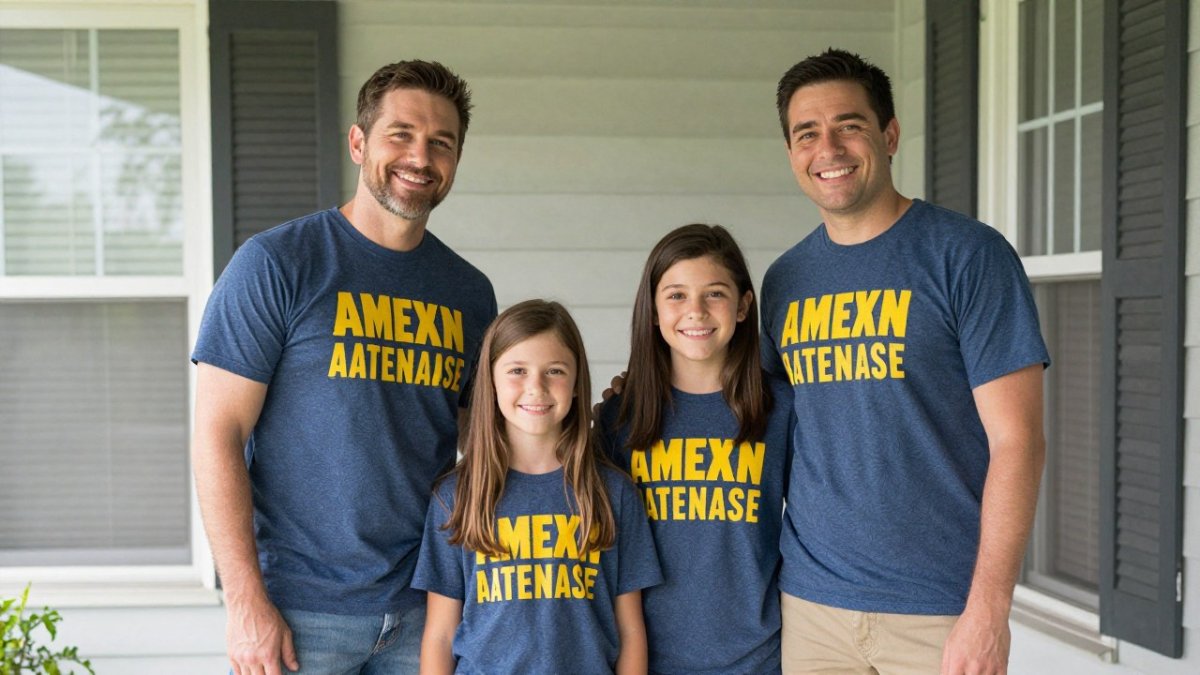
Matching shirts work best when the design is consistent but the fit is right for each person. Heavyweight hoodies and graphic tees both offer good options for different ages.
Toddler and Kids' Sizing and Fit
Children grow quickly, so size planning matters more than usual. Check the size chart before ordering, and consider sizing up for hoodies so a child can layer comfortably. Kids' tees are often cut shorter and narrower, so measure a favorite shirt your child already owns and compare it with the chart.
Unisex and Adult Fit Notes
If a family includes both, try to order sizes that keep the group's overall look balanced. A crew neck is the most forgiving option for mixed adult sizing, while fitted or V-neck styles can look different on each person.
Down Syndrome Awareness Month Shirts and Event Timing
October is Down Syndrome Awareness Month, and March 21 is World Down Syndrome Day (World Down Syndrome Day: Together against loneliness). Those two dates drive most family shirt purchases, and they also create the two problems families run into: demand spikes and limited-run designs sell out. Planning backward from the event date is the single most useful habit for avoiding both.
Build a backward timeline from your event date
Start with the date you need the shirts in hand, not the event date itself. A family photo session, a school assembly, a community walk and a fundraiser all need shirts a few days early for washing, trying on and swapping sizes. A workable pattern looks like this:
- Event date minus 3 to 5 days: shirts in hand, washed once, sizes confirmed.
- Minus 2 to 3 weeks: order placed for stock (non-custom) designs.
- Minus 4 to 6 weeks: order placed for custom or handmade listings, which often queue behind other orders.
Watch out: ordering in the final week before a walk is the most common way families end up with mismatched sizes, because the design they wanted is gone and they substitute whatever is left in stock.
Plan for limited editions and sell-outs
A simple hedge is to order one extra youth size in the group design. Kids grow, guests join, and a spare shirt is easier to absorb than a second order that arrives after the event.
Coordinate the group before the event, not at it
Timing is only half the job; the other half is making the group look intentional. A few coordination habits pay off in photos and in person:
- Pick one anchor design and vary only the garment. The same graphic on adult tees, youth tees and a hoodie reads as one set; three different graphics do not.
- Agree on a color base. Blue and yellow are the awareness colors, so build the group around those tones and let neutrals (white, gray, khaki, camo) carry the rest.
- Decide who wears the boldest piece. Usually one adult in the hoodie or the brightest tee anchors the photo, with kids in the simpler tee version.
For a photo session, solid bottoms in a neutral tone keep the graphics from competing with each other, and matching tops with varied bottoms usually photographs better than head-to-toe matching. If the event is outdoors in October, a hoodie for the adults and a tee plus layer for the kids keeps everyone comfortable without hiding the design.
Match the shirt to the event type
Awareness month and awareness day pull different kinds of events, and the shirt should fit the setting:
- School functions and classroom events: a simple tee with a clear message reads well in a group photo and is comfortable for a full day.
- Community walks and fundraisers: lightweight tees for warm-weather walks, hoodies for cool-morning registration.
- Family photo sessions: one anchor design across all ages, with the boldest piece on the tallest adult.
Once the date is set and the group is coordinated, the remaining decisions are the design, the sizes and whether the purchase supports a cause, which is where the next check matters.
The timing guidance in this section comes down to a few concrete intervals worth keeping in view when planning a family order.
| Timing point | Action | Interval |
|---|---|---|
| Event date minus 3 to 5 days | Shirts in hand, washed once, sizes confirmed | 3-5 days before |
| Stock designs | Place order | 2-3 weeks before |
| Custom or handmade listings | Place order | 4-6 weeks before |
| Design and sizes | Choose design, collect sizes from all members | 6-8 weeks before |
| Extra youth size | Order one spare in group design | Before the event |
How to Check Whether a Shirt Purchase Supports a Charity
Many buyers want their purchase to help a cause, but not every shirt marked "awareness" sends money to a charity. The gap most apparel content leaves open is the how: not just "look for a named beneficiary," but the specific places to look and the specific language that separates a verifiable donation from a vague one. Here is the check, in the order it is worth doing.
Step 1: Find the named beneficiary and the stated amount
A credible listing names the organization and states either a flat amount per shirt or a percentage of proceeds. "A portion of sales" is not a number, and without a number there is nothing to verify. Look for language like "$5 from each shirt goes to [organization]" or "10% of net proceeds." Note whether the figure is based on gross sales or net proceeds, the difference is large, and net-proceeds language is common because it accounts for production and platform fees.
Step 2: Confirm the organization is real and eligible
If the listing names an organization, spend two minutes there before you buy. A named beneficiary that does not appear, or appears with a revoked status, is a reason to ask questions.
Step 3: Check the donation timeline and mechanism
Good brands explain how and when the money moves: is the donation made monthly, quarterly, or after the campaign closes? Is it a direct payment to the organization, a match, or an in-kind donation of shirts? Each is legitimate, but they are not the same thing, and the listing should say which one applies. A stated timeline, "donations remitted within 30 days of the campaign close", is a sign the brand has done this before.
Step 4: Look for reporting after the fact
A brand that donates usually says so afterward: a total raised, a photo of the check presentation, a named recipient and a date. Past reporting is stronger evidence than a forward-looking promise, because it shows the mechanism has actually run. If a brand has sold awareness shirts for several seasons and never reported a total, that is a pattern worth weighing.
Step 5: Read the cause-marketing language carefully
Cause marketing has its own vocabulary, and the words matter. "Supports," "raises awareness for" and "in partnership with" can describe a relationship that involves no money at all. "Proceeds benefit" and "a percentage of sales goes to" describe a financial transfer.
Watch out: a shirt can be a legitimate awareness product without donating anything, many families buy purely for visibility, so the question is not whether a shirt is "good," but whether the donation claim is specific enough to verify before you place a group order.
A quick pre-order checklist for family orders
Before a larger order, run these five checks and keep the answers together:
- Named beneficiary, with a link to the organization.
- Stated amount or percentage, and whether it is gross or net.
- Donation timeline and mechanism (direct payment, match, or in-kind).
- The organization's status confirmed through the IRS Tax Exempt Organization Search (Search for tax exempt organizations).
If a listing clears all five, the donation claim is about as verifiable as apparel cause marketing gets. If it clears two or three, ask the brand directly before ordering for a group, a short email is usually enough to get the missing detail in writing.
Caring for Graphic Prints and Choosing Ethical Materials
Graphic prints are the part of a shirt that fades first if it is washed carelessly. A few habits make a real difference:
- Turn shirts inside out before washing.
- Use cold water and a gentle cycle.
- Avoid high-heat drying, which can crack or dull the print.
- Hang or lay flat to dry when possible.
Materials matter too. Cotton-rich blends are comfortable and breathable, while heavier fleece holds up well for outerwear. Ask about sourcing and production if you care about sustainability. A brand that is transparent about fabric and manufacturing is easier to trust than one that says nothing at all.
Choosing Your Family's Shirts and Placing Your Order
Start by deciding on the design and message everyone agrees on. Then list each family member's size, using the brand's size chart rather than guessing.
Check the charity details, confirm the return and sizing policy, and order early if you need the shirts for a fixed date. You can also review five practical ways to verify a clothing brand's charitable impact. For a step-by-step method, see how to verify charity donations from apparel brands.
Choosing a shirt your family can wear together is a small step with real meaning. Love Revolt Clothing offers awareness designs built for comfort and everyday wear, with a portion of proceeds supporting Down Syndrome awareness and other causes.
Frequently Asked Questions
What are good shirt ideas for Down syndrome awareness?
Good options include simple graphic tees with the blue and yellow awareness colors, shirts that carry a short message about inclusion or the extra chromosome, and family designs that work across sizes. Crew neck and unisex fits are common, and many shoppers prefer soft cotton for everyday wear. Pick a message your family is comfortable repeating in public, and check that the shirt is offered in the sizes you need before ordering a set.
What colors are associated with Down syndrome awareness?
Blue and yellow are the widely recognized colors of Down syndrome awareness, and they show up across World Down Syndrome Day merchandise and community events. Many awareness shirts use one or both colors in the graphic or the garment itself. Choosing a shirt in these colors makes it easy for others to recognize the cause without a written explanation.
How can I tell whether a Down syndrome awareness shirt supports a charity?
Look for a named beneficiary, a stated percentage or dollar amount per sale, and a way to contact the seller about where proceeds go. A listing that only uses awareness language without naming an organization or describing how money is allocated is harder to verify. You can ask any seller for current details before buying. Pricing varies by product, size and quantity, so check the seller's site for current prices.
